
Concrete Permits in Highland Village, TX: What Homeowners Need to Know
Concrete Permits in Highland Village, TX: What Homeowners Need to Know
Before breaking ground on a concrete project in Highland Village, it’s worth spending 15 minutes understanding the permit landscape. Some projects sail through without any paperwork. Others require engineered drawings and inspections. Getting this wrong can mean tearing out completed work at your expense — a scenario no homeowner wants.
Here’s a straightforward breakdown of what requires a permit, what doesn’t, and how to navigate the process in Highland Village and Denton County.
What Does and Doesn’t Require a Permit
Concrete patios do NOT require a permit if they are not attached to the house foundation. A freestanding backyard patio slab — even a large one — can be poured without City of Highland Village Building Inspections involvement, as long as it’s detached from the structure and meets setback requirements.
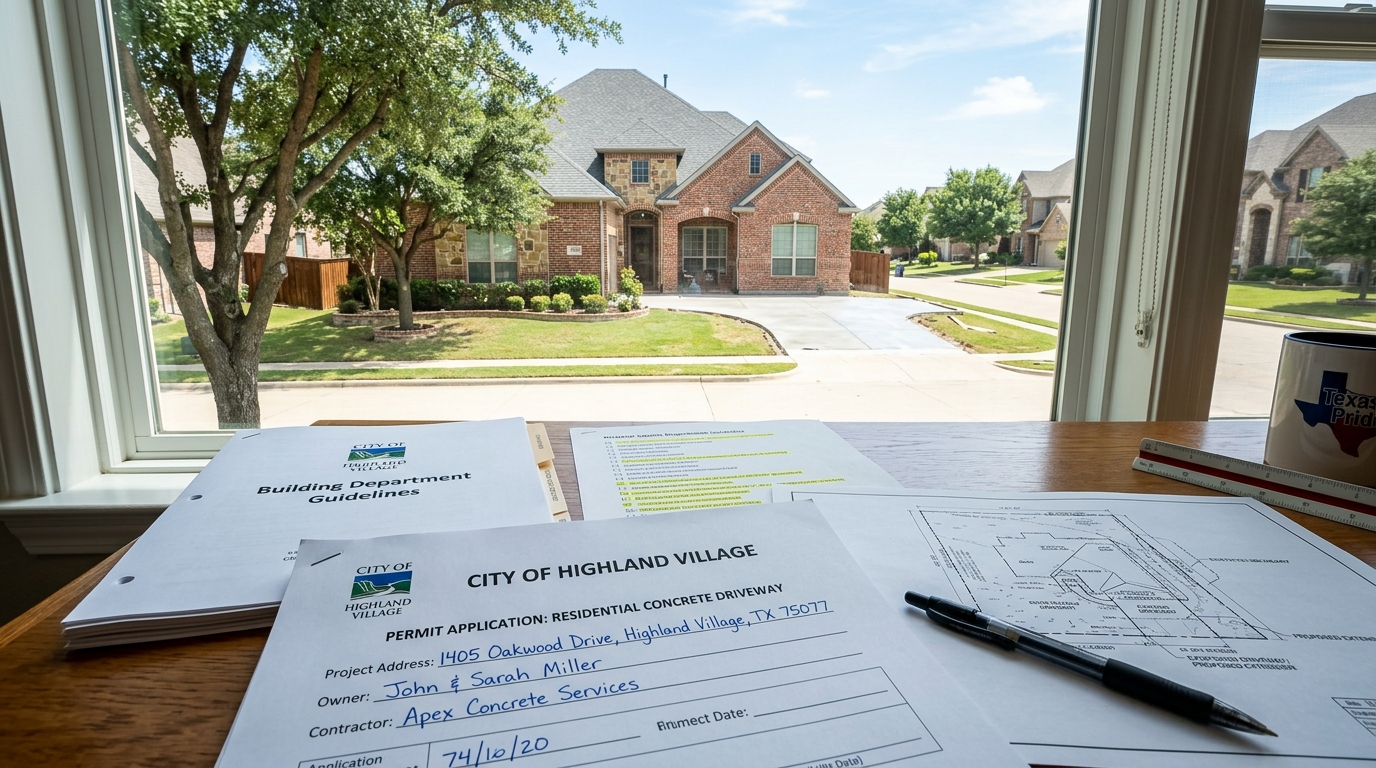
Driveways and structural concrete require permits through City of Highland Village Building Inspections. A new driveway, driveway replacement, or driveway extension is considered a structural improvement and requires a building permit before work begins.
Engineered foundation plans with a Texas PE seal are typically required for structural work. Any concrete project that bears structural loads — foundation pads, retaining walls over a certain height, or concrete attached to the home’s foundation — must be designed by a licensed Professional Engineer registered in Texas. The engineer’s seal on the drawings is a requirement, not just a recommendation.
Key rule of thumb: if the concrete supports structure, connects to structure, or affects drainage in the right-of-way, assume a permit is needed and confirm with the city before starting.
How to Apply for a Concrete Permit in Highland Village
Permits for concrete work in Highland Village are administered through the City of Highland Village Building Inspections Department. The process generally works as follows:
-
Prepare your documents. For most residential driveway permits, you’ll need a site plan showing the proposed driveway footprint, dimensions, and distance from property lines. Structural projects require engineered drawings with a Texas PE seal.
-
Submit your application. The City of Highland Village accepts permit applications at City Hall. Many routine residential permits can also be submitted online through the city’s permitting portal. Check the city’s official website for the current submission method.
-
Pay the permit fee. Fees vary by project type and valuation. A straightforward driveway permit typically runs $50–$150, though this changes periodically. Structural projects with engineering review cost more.
-
Schedule inspections. Once your permit is approved, inspections are required at specific stages — typically before the pour (to verify forms and rebar) and after curing. Your contractor should coordinate these.
-
Receive final approval. After all inspections pass, the permit is closed and you have documentation of the completed, approved work.
A licensed contractor will typically pull permits on your behalf as part of the project. If you’re hiring for a driveway installation or replacement, confirm that permit pulling is included in the scope of work.
Typical Permit Timeline in Highland Village
For routine residential concrete permits in Highland Village, plan on:
- Standard review: 3–7 business days for straightforward residential projects
- Structural review with engineering: 2–4 weeks, depending on city workload
- Inspection scheduling: Usually 24–48 hours’ notice required
Spring and summer are peak seasons for construction permits in Denton County — both because homeowners are more active and because contractors are busiest. If you’re planning a spring pour, submit your permit application in late winter to avoid delays.
HOA Considerations in Highland Village
The City of Highland Village has active homeowners associations in many neighborhoods, including Briarhill Estates, Highland Shores, Lakewood, and The Peninsula. A building permit from the city does not substitute for HOA approval — these are separate processes.
Most Highland Village HOAs require:
- Prior written approval before any exterior concrete work begins
- Specific finish requirements (some communities prohibit certain colors or patterns that don’t match neighborhood aesthetics)
- Contractor licensing verification — some HOAs require contractors to be pre-approved or provide proof of insurance and licensing
- Completion timeframes — unfinished projects can trigger HOA violations
Submit your project to your HOA architectural review committee at the same time you submit your city permit application. HOA review timelines vary widely — some committees meet monthly, which can add four to six weeks to your project schedule if you miss a meeting.
What Happens If You Skip the Permit?
Unpermitted concrete work creates real problems down the road:
- Difficulty selling your home. Buyers’ inspectors and real estate attorneys increasingly flag unpermitted improvements. You may be required to demolish or obtain a retroactive permit to close.
- Insurance complications. A homeowner’s insurance claim related to unpermitted work can be denied.
- City enforcement. If Highland Village inspectors flag unpermitted work during a related inspection, you may be required to remove the concrete and start over with proper permitting.
The permit process exists partly to protect you. An inspection before the pour confirms your forms, rebar, and sub-base meet code — catching problems before they’re buried under concrete.
Contact Highland Village Concrete today for a free estimate. Call (888) 376-0955 or reach out online.