
Concrete Sealing: Why It's Essential in North Texas
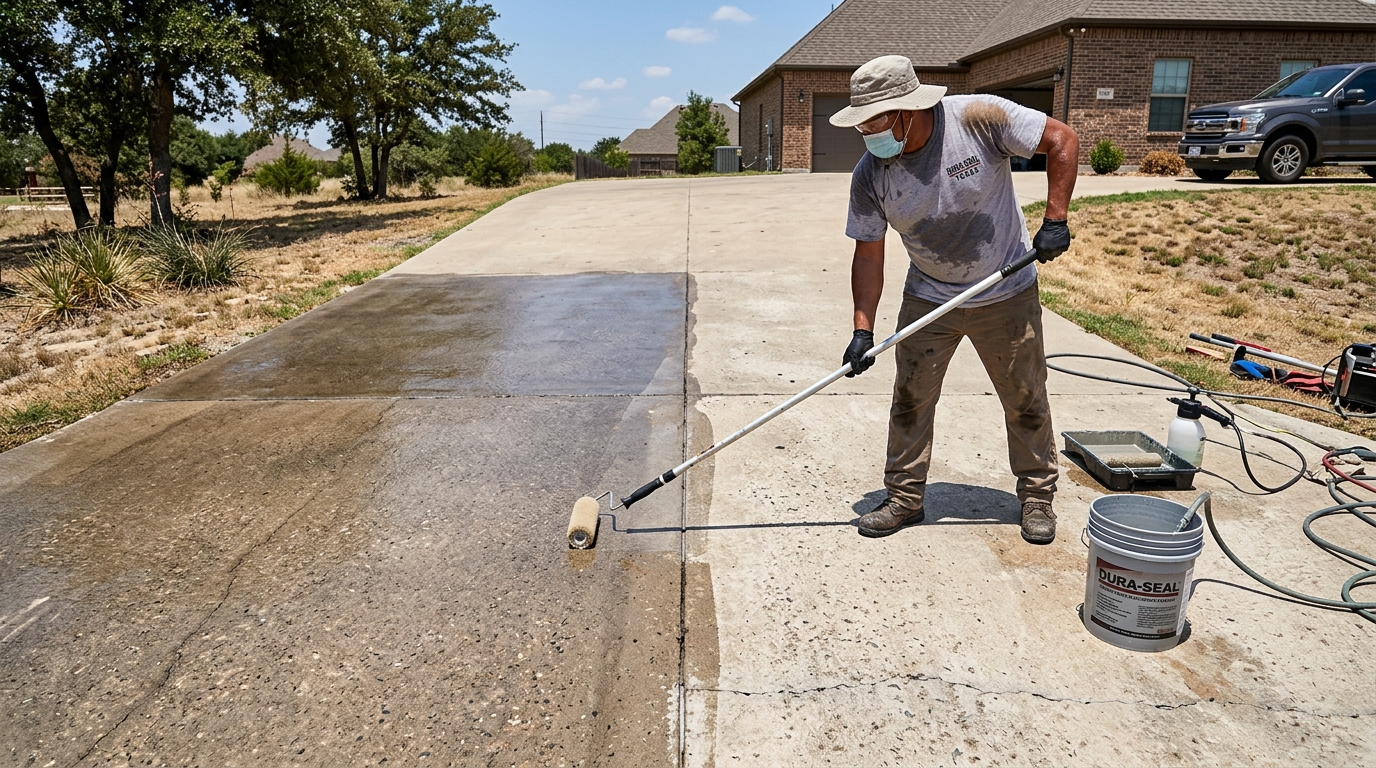
Concrete Sealing: Why It’s Essential in North Texas
Concrete sealing is one of the least expensive and most impactful maintenance tasks a Highland Village homeowner can perform. Yet it’s also one of the most commonly skipped — and the most common reason concrete fails before its time in North Texas’s demanding climate.
Here’s why sealing matters more in Denton County than almost anywhere else in the country, and how to do it right.
The North Texas Environment Attacks Unsealed Concrete
Denton County features expansive clay soils that can expand up to 10% with moisture changes, causing foundation movement. Hot summers exceed 100°F with high humidity. Cold winters bring freeze-thaw cycles. Each of these conditions is hard on concrete — but they’re dramatically harder on unsealed concrete.
UV exposure: Texas sun is intense. UV rays break down the cement paste on the surface of concrete, causing chalking, fading, and surface erosion. An unprotected concrete driveway in Highland Village can show visible UV degradation within 3–5 years. Sealer acts as a sacrificial layer that absorbs UV instead of letting it attack the concrete itself.
Clay soil moisture cycling: Water absorbed into the edges and underside of a concrete slab accelerates the expansion-contraction cycle in the clay beneath it. Sealing the surface doesn’t eliminate sub-base moisture, but it significantly slows water infiltration through the surface and edges — reducing the moisture fluctuations that drive soil movement.
Freeze-thaw damage: When water gets into concrete pores and freezes, it expands and creates micro-cracks that compound over multiple cycles. North Texas experiences 6–10 days per year cold enough to cause freeze-thaw stress. Sealing closes the pore structure and dramatically reduces water infiltration.
Oil and chemical stains: Driveways absorb motor oil, transmission fluid, and fertilizer runoff. These stains are difficult to remove from unsealed concrete and can accelerate surface degradation. Sealer creates a barrier that makes spills easier to clean and prevents deep penetration.
How Often Should You Seal Concrete in Texas?
In cooler northern climates, concrete can go 3–5 years between sealing. In North Texas, the combination of UV intensity, heat, and wet-dry soil cycles means every 2–3 years is the appropriate interval.
Signs your concrete needs resealing:
- Water no longer beads on the surface (the “bead test”)
- The surface looks dull, chalky, or faded
- You haven’t sealed in more than 3 years
- Light surface stains are absorbing rather than wiping off
Spring (March–May) and early fall (September–October) are the best times to apply sealer in Highland Village. Ideal application temperatures are 50–85°F with no rain forecast for 24–48 hours. Avoid applying sealer in summer heat above 90°F — it cures too quickly and can result in a blotchy, uneven finish.
Types of Concrete Sealers
Penetrating Sealers (Silane/Siloxane): Penetrating sealers soak into the concrete and react chemically to block water infiltration without changing the surface appearance. They’re invisible when dry — no sheen, no color change — making them ideal for natural-finish concrete where you don’t want a “wet look.” They’re particularly effective for protecting concrete from the ground up by blocking moisture infiltration through the surface.
Penetrating sealers are the best choice for driveways, sidewalks, and any concrete where you want protection without changing the look. They typically last 3–5 years before reapplication and cost $0.50–$1.00 per square foot professionally applied.
Acrylic Sealers: Acrylic sealers form a film on the surface that provides both protection and a visible finish — from a low-sheen matte to a high-gloss wet look. They’re the standard choice for stamped concrete patios and decorative concrete where you want to enhance color and pattern visibility.
Acrylics need reapplication more frequently than penetrating sealers in Texas — every 1–3 years depending on traffic and UV exposure. They cost $0.75–$1.50 per square foot applied professionally.
Epoxy and Polyurethane Coatings: High-performance coatings used for garage floors and commercial applications. They provide excellent abrasion resistance and chemical resistance, but are overkill for most residential driveways and patios.
DIY vs. Professional Sealing
DIY sealing is feasible for basic acrylic or penetrating sealers on small, accessible surfaces. The main risks with DIY application are:
- Uneven application leaving lap marks or missed areas
- Applying over a dirty or contaminated surface (the most common DIY mistake)
- Using the wrong product for the surface type
- Applying in the wrong temperature or weather conditions
Professional sealing ensures proper surface preparation (cleaning, degreasing, and allowing full drying), the right product for your specific surface, and even application. For stamped concrete, pool decks, or any decorative finish, professional application is strongly recommended — mistakes are visible and hard to fix.
Professional sealing costs $0.50–$1.50 per square foot depending on surface type, product, and condition. For a 600 square foot driveway, that’s $300–$900 every 2–3 years — a small fraction of the cost of concrete repair or replacement.
How Sealing Prevents the Most Common Highland Village Concrete Failures
The most common concrete failures in Highland Village — wide cracks from clay soil movement, surface spalling, joint deterioration, and staining — are all significantly reduced by consistent sealing. Sealed concrete:
- Absorbs less moisture at edges, reducing the soil expansion cycle that causes cracking
- Resists surface spalling from freeze-thaw and chemical exposure
- Keeps joints functional longer by preventing water infiltration
- Resists oil and stain penetration that leads to surface degradation
For professional sealing, inspection, and concrete repair and maintenance services, our team serves all of Highland Village and Denton County.
Contact Highland Village Concrete today for a free estimate. Call (888) 376-0955 or reach out online.