
Pool Deck Options: Concrete vs. Pavers in the Highland Village Area
Pool Deck Options: Concrete vs. Pavers in the Highland Village Area
Choosing a pool deck surface is one of the most important decisions in a pool project — and one of the most frequently regretted when the wrong choice is made. In Highland Village, where pools see intense summer use and the underlying clay soil never fully sits still, the decision between concrete and pavers has real consequences for comfort, safety, and maintenance costs.
Here’s a practical comparison to help you decide.
Concrete Pool Decks: The Case for Poured Concrete
Concrete is the most common pool deck surface in Highland Village and across Denton County, and for good reason. A properly poured and finished concrete deck delivers 20–35 years of reliable service with modest maintenance.
Advantages of concrete pool decks:
- Cost: Concrete runs $8–$12 per square foot for standard finishes, making it the most affordable option for large pool deck areas.
- Seamless surface: No joints for weeds to grow in, no shifting individual pieces, no sand washing out from between pavers after heavy rains.
- Custom finishes: Broom finish, exposed aggregate, stamped patterns, and cool deck coatings can all be applied to poured concrete.
- Structural stability: A single continuous slab, when properly reinforced and poured on a prepared sub-base, moves as one unit with fewer differential settling issues than individual pavers.
Concrete finish options for Highland Village pools:
Broom Finish is the standard — practical, slip-resistant, and affordable. It’s not glamorous, but it holds up perfectly and doesn’t get as hot as smooth finishes.
Exposed Aggregate reveals decorative stone within the concrete mix, creating a textured, natural-looking surface with excellent traction. The varied surface also hides footprints and surface dirt better than smooth concrete.
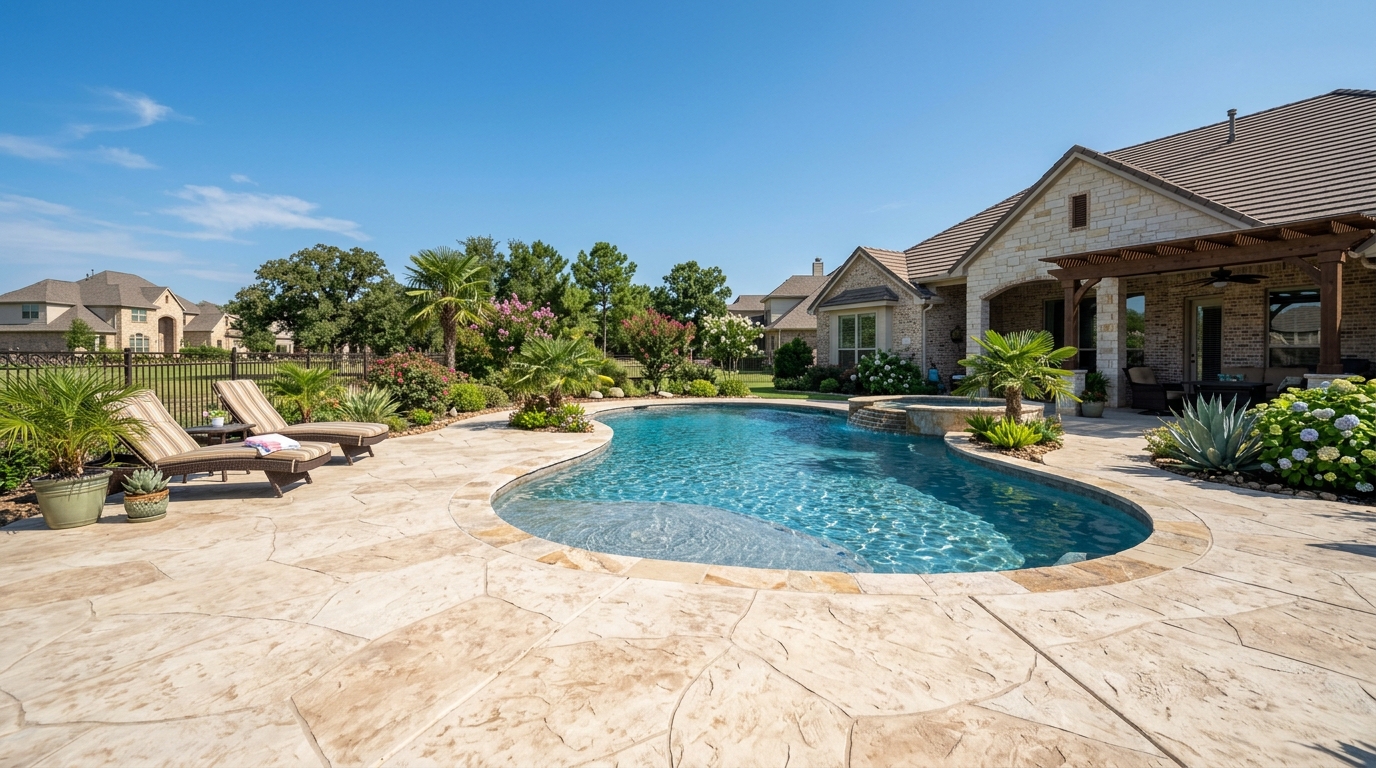
Stamped Concrete ($12–$20 per square foot) adds flagstone, slate, or cobblestone patterns for a high-end look. Lighter stamped colors stay cooler than dark stone alternatives and can dramatically elevate the appearance of the pool area.
Cool Deck Coating is a spray-applied overlay popular in Texas specifically because it stays significantly cooler underfoot than standard concrete or pavers — sometimes 30–40°F cooler on a hot day. It’s a practical choice for pools that get heavy daytime use in Highland Village summers.
Pavers: The Case for Individual Stone Units
Concrete pavers offer a different set of trade-offs that appeal to homeowners prioritizing aesthetics and repairability.
Advantages of pavers:
- Visual variety: Travertine, tumbled limestone, brick, and concrete pavers come in dozens of colors, shapes, and textures.
- Easy spot repair: Individual pavers can be replaced if one cracks or shifts, without disturbing the rest of the deck.
- Natural look: Travertine in particular gives a high-end resort appearance popular in upscale Highland Village neighborhoods like The Peninsula and Lakeside Estates.
Disadvantages of pavers in Highland Village:
- Cost: Travertine and natural stone pavers run $15–$30+ per square foot installed. Even basic concrete pavers cost $12–$20 installed.
- Joint maintenance: The sand or gravel between pavers requires periodic replacement, especially after heavy North Texas rains. Weeds and ants colonize paver joints reliably.
- Clay soil movement: This is the critical issue in Denton County. The Blackland Prairie clay that underlies Highland Village expands and contracts dramatically with moisture changes. Individual pavers react to this movement by shifting, settling unevenly, and creating trip hazards over time. A concrete slab distributes this movement across the whole surface; pavers concentrate it at individual points.
- Heat retention: Natural stone and concrete pavers absorb and retain heat. Barefoot walking on light-colored pavers at 2 PM in July can be painful.
Which Is Better for Highland Village?
For most Highland Village homeowners, concrete with an upgraded finish provides the better long-term value. The expansive clay soil in Denton County is fundamentally harder on paver systems than on a properly reinforced continuous concrete slab. The joint maintenance, weed control, and re-leveling that paver decks require in this climate adds up over years.
If the primary goal is visual impact and budget is not a major constraint, travertine or high-quality pavers on a properly prepared sub-base can look excellent and perform well for 10–15 years before significant relaying work is needed.
For most budgets and most pool sizes, a stamped or exposed aggregate concrete deck provides 90% of the visual appeal at a fraction of the long-term maintenance.
Heat Management: The Key Factor in Texas
Whatever surface you choose, heat management is critical for a Highland Village pool deck. Some practical guidelines:
- Choose lighter colors — they reflect rather than absorb solar heat
- Avoid dark, smooth surfaces — they become uncomfortably hot in direct afternoon sun
- Consider cool deck coating on any concrete surface that faces west or south
- Textured finishes (broom, exposed aggregate, stamped) stay cooler than smooth finishes because texture breaks up direct solar contact
For full details on pool deck installation and available finishes, visit our pool decks service page.
Contact Highland Village Concrete today for a free estimate. Call (888) 376-0955 or reach out online.