
Retaining Walls on Expansive Clay Soil: What Texas Homeowners Need to Know
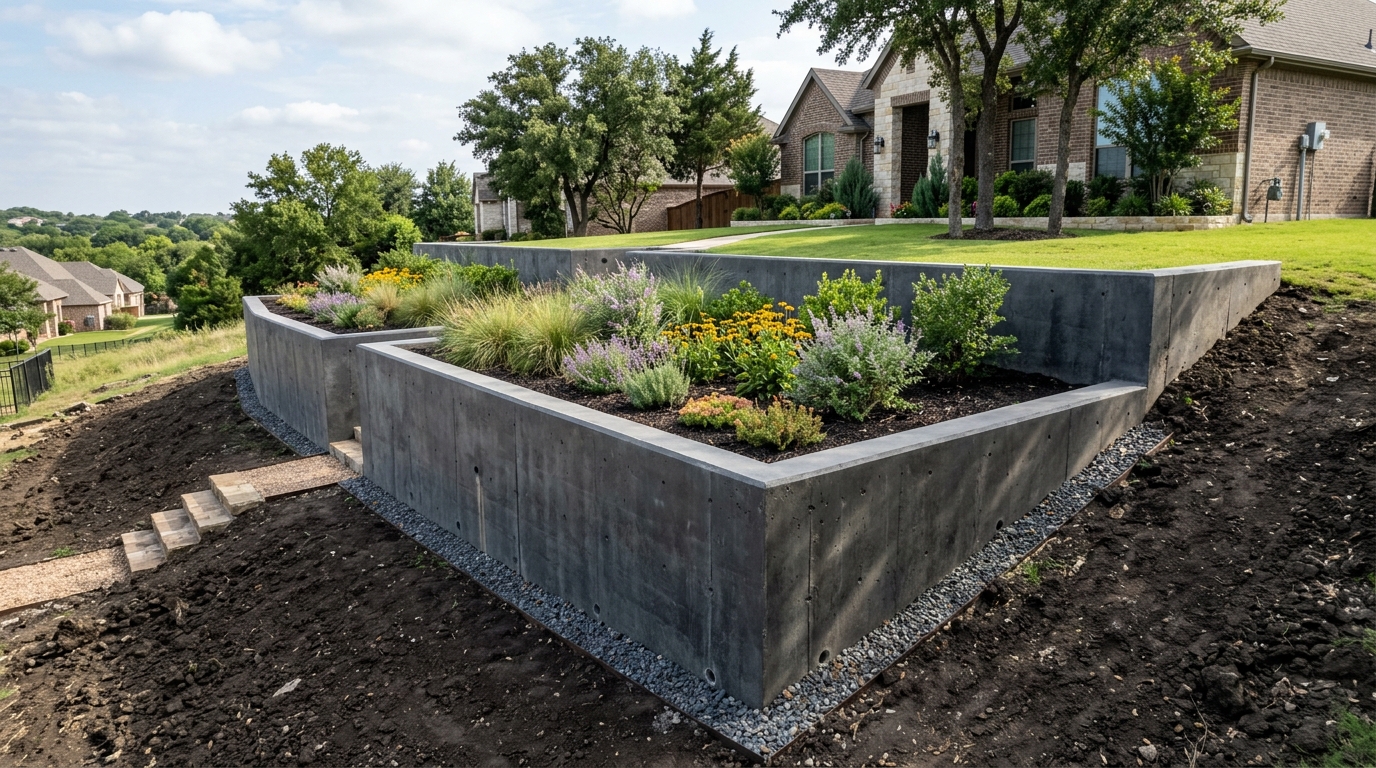
Retaining Walls on Expansive Clay Soil: What Texas Homeowners Need to Know
Building a retaining wall in Highland Village requires understanding the ground beneath it. Denton County’s Blackland Prairie clay soils can expand up to 10% with moisture changes — generating enormous lateral pressure against any structure attempting to hold them back. A retaining wall designed for sandy or loamy soil will fail in Highland Village’s clay environment. Here’s what the local conditions demand.
Why Highland Village’s Clay Soil Makes Retaining Walls Critical — and Challenging
The same expansive clay that causes foundation movement throughout Denton County also pushes against retaining walls with forces that can topple improperly built structures. When rain saturates the clay, it expands in all directions — including horizontally against any wall holding it back. During drought, the clay shrinks and pulls away, then returns with the next rainfall.
This repeated expansion and contraction is the primary reason retaining walls fail in Highland Village. A wall that seems solid in year three may begin to lean, crack, or buckle by year eight as the cumulative effect of dozens of wet-dry cycles takes its toll.
The solution isn’t to avoid retaining walls — they’re essential for managing grades and erosion in North Texas’s varied terrain, especially in neighborhoods like Canyon Creek Estates and Chapel Hill where lots have significant elevation changes. The solution is to design and build them correctly for the specific soil conditions.
Design Considerations for Texas Clay Soil
1. Drainage is the most critical design element. The lateral pressure a retaining wall must resist is dramatically higher when the soil behind it is saturated. A wall designed for moist (but not saturated) soil may be overwhelmed by a fully saturated backfill during a heavy North Texas rain event.
Proper drainage design for Highland Village retaining walls includes:
- Gravel backfill (crushed limestone or similar) immediately behind the wall to prevent clay from direct contact
- Perforated drain pipe (French drain) at the base of the wall to carry water away
- Weep holes in concrete walls spaced every 6–8 feet to allow water to escape
- Surface drainage graded away from the top of the wall
2. Wall depth and footing. The footer must extend below the active soil zone — the layer most affected by moisture cycling. In Denton County, footings for concrete retaining walls typically go 18–24 inches below grade. Skimping on footing depth is a common cause of wall rotation and failure.
3. Batter and geometry. Walls that lean slightly back into the retained soil (typically 1 inch per foot of height) resist overturning forces better than perfectly vertical walls.
4. Reinforcement. Concrete retaining walls in Texas clay environments should include rebar or be of sufficient mass to resist the soil pressures they’ll face. For walls over 3 feet tall, engineer-specified reinforcement is essentially mandatory.
Retaining Wall Permit Requirements in Highland Village
Structural retaining walls in Highland Village require permits through City of Highland Village Building Inspections. In practice, walls over 4 feet tall (measured from the bottom of the footing to the top of the wall) almost universally require:
- A building permit
- Engineered drawings with a Texas PE seal
- Inspections before and after pour
For walls under 4 feet, check with the city — thresholds can vary based on the wall type, location, and what it’s retaining. Walls adjacent to property lines, easements, or drainage ways may have additional requirements regardless of height.
HOA approval is a separate requirement in most Highland Village neighborhoods. Many communities have aesthetic standards for retaining wall materials and finishes visible from the street.
Material Options for Retaining Walls in Texas
Poured Concrete is the most durable option for Highland Village’s soil conditions. A properly reinforced poured concrete wall handles clay soil pressure better than any other material and can be designed to exact engineering specifications. It’s also the most compatible with matching existing concrete features on your property.
Concrete Block (CMU) is common for walls in the 4–8 foot range. Structural CMU walls are reinforced with rebar and filled with grout, providing strength similar to poured concrete with more design flexibility.
Segmental Retaining Wall (SRW) Block (products like Allan Block or Versa-Lok) work well for walls under 4–5 feet. They rely on gravity and geogrid reinforcement rather than a poured footer. The drainage design is particularly important with these systems in clay soil.
Timber or Railroad Ties are not recommended for long-term retaining walls in Denton County. Organic materials in direct contact with expansive clay deteriorate faster in the Texas climate.
Retaining Wall Costs in Highland Village
Concrete retaining walls in the DFW area run $8–$15 per square foot of face area for most residential projects. A wall that’s 30 feet long and 4 feet tall (120 square feet of face area) typically costs $960–$1,800 for basic concrete block construction, or more for poured concrete with full engineering.
Factors that push costs up:
- Engineering requirements for walls over 4 feet
- Deep footing requirements in expansive clay
- Drainage system installation
- Difficult access on sloped or tight lots
For retaining walls that hold significant grades or are near structures, professional engineering and quality construction is not a place to cut costs. A failed retaining wall in Highland Village can cause significant damage to grades, drainage, and adjacent structures.
To discuss retaining wall options for your property, contact our team for a free site evaluation.
Contact Highland Village Concrete today for a free estimate. Call (888) 376-0955 or reach out online.